How to Get Going with Using SFL
So let's build a sentence
| Some more 'building blocks' | are described | in this section. |
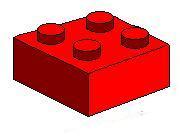
|
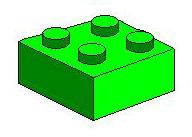
|
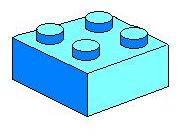
|
If you think about it, grouping words in the manner shown above is not so unfamiliar. In fact, most of us do it unconsciously and without even realizing it. Take the famous joke by comedian Groucho Marx (As in Fontaine, 2012 p3):

Artwork (c) Alison Price |

Artwork (c) Alison Price |
| "This morning, I shot an elephant in my pyjamas!" | What he was doing in my pyjamas, I'll never know. |
The joke only works because we can instantly recognize the function of the word group in my pyjamas and, for the purpose of the joke, attribute an alternative absurd meaning to it. There is no actual punctuation in traditional grammar to help identify this word group, but proficient readers can recognize and see such blocks of meaning instantly. This is no easy task for many learners with poor language or literacy skills, so why not actually teach the language in similar chunks of functional meaning?
The 'experiential' in Systemic Functional Grammar (SFG) identifies real functional building blocks of word-groups rather than the more abstract traditional concepts such as verb, noun, adjective, etc. A basic phrase or sentence can thus be broken up into three basic types of building blocks as follows:
| Participant |
'Who or What' | A nominal wordgroup (NG) - The actors and objects which take part in the action; |
| Process |
'Does, makes or is (by something or someone)' | A verbal wordgroup (VG) - The action being done or taking place - (Note: 'to be' might also be considered as an 'action of being'); |
| Circumstance |
'When, where, how' | An adjectival wordgroup (AG) - Factors restricting the space and time boundaries of the action and participants. An important property of circumstances is that they can often be left out of a sentence without affecting its grammatical completeness. |
We now have word group types which can relate to not only objects, people, and ideas, but also actions, states of being, time, manner, and places. In fact, everything we want to talk, read, or write about!
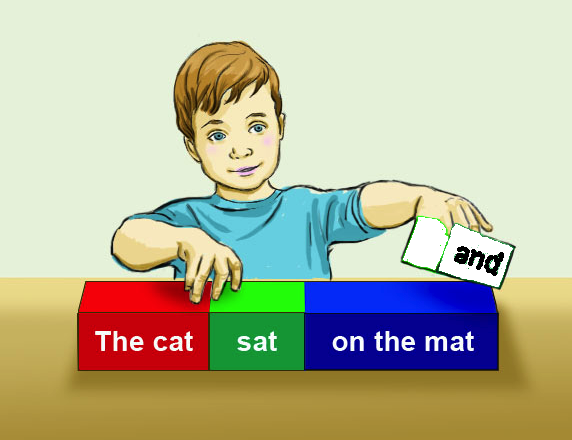
|
Note: It's not really necessary to teach very young learners the jargon or 'Meta-Language'. For example, you could use: '[who or what]', '[the doing and being words]', and '[when, where and how]' respectively. |
An example sentence as functional building blocks
| Participant (who/what) | Process (does/is) | Circumstance (where/when/how) |
|---|---|---|
| Annie and Bridget | live | in London. |
|
|
|
|
Using colored marker pens, students can search real texts and identify some of the blocks of words which have been introduced and rehearsed in advance.
* How to determine the type and function of word groups:
The colors used here are arbitrary, but you may like to think of the scheme as follows:
| Red (the participant) | Something standing still or stable and awaiting interaction |

|
| Green (the process) | Movement, change, and/or action |

|
| Blue (the circumstance) | The background sky which frames the contextual landscape |

|
Thanks to Ruth Mulvad formerly of (http://www.videnomlaesning.dk) for introducing us to this Metaphor. The color code was originally suggested by Ruth French, the metaphor first used as part of Lexis Education's professional development programme for teachers (http://www.lexised.com).
* The basic idea of using this classification for word groups has been adapted from the concept of the "experiential" analysis of texts in Systemic Functional Linguistics. Please note that we do not intend to adhere fully to the academic rules of the SFL Transitivity concepts in these ideas for school classroom teaching.